 By Owen Palmer
Updated November 2026
Shopping for the best dual screen portable monitor usually starts with one problem: your laptop screen is too small for the work you need to do. Whether you’re juggling spreadsheets and a video call on the road or stretching a timeline across two panels at a hotel desk, a second display can change how you work. This guide compares six models using the criteria that matter most for portable use: panel size and resolution, connection type (USB-C, HDMI, or both), stand and rotation options, weight and thickness, and how well each one suits laptop-only setups. The specifications below come from manufacturer listings and commonly reported owner feedback. We did not run our own tests.
Our top picks at a glance
- 1
 TOP CHOICEBest overallASUS ZenScreen Duo MB14FCD 14 Inch Foldable Dual-Screen Portable MonitView on Amazon
- 2
 TOP CHOICEBest for stacked travel setupsInnoView Dual Portable Monitor 15.6" 1920×1080 Dual Stacked Foldable MView on Amazon
- 3
 TOP CHOICEBest for color-sensitive workVisionOwl Portable Monitor Dual 15.6 Inch 1080P FHD 107% sRGB FoldableView on Amazon
- 4
 Best budget pick15.6" Portable Dual Monitor, Foldable Laptop Screen Extender, Double PView on Amazon
- 5
 Best for ultralight carryLaptop Screen Extender 1.87lbs Ultra-Portable & Ultra Slim, 14.2" FHDView on Amazon
- 6
 Best for mixed-device useOne Cable USB-C Extended Monitor, Dual Travel Screen for 12"-17'' LaptView on Amazon
Our Top Picks
Quick Comparison
| Product | Best for | Key feature |
|---|---|---|
| ASUS ZenScreen Duo MB14FCD | Overall balance of build and image quality | Pass-through charging and rotation |
| InnoView Dual Portable Monitor 15.6″ | Small kitchens and stacked travel setups | 315° screen adjustment |
| VisionOwl Portable Monitor Dual 15.6 Inch | Color-sensitive work | 107% sRGB coverage and built-in kickstand |
| 15.6″ Portable Dual Monitor Foldable Screen Extender | Budget-conscious buyers | Ultra-slim foldable design |
| Laptop Screen Extender 14.2″ FHD | Ultralight carry | About 1.87 lbs |
| One Cable USB-C Extended Monitor | Mixed-device use | 360° rotation with single-cable connection |
ASUS ZenScreen Duo MB14FCD 14 Inch Foldable Dual-Screen Portable Monitor, 1920×1200 Resolution, Rotate, Pass-Through Charging
ASUS ZenScreen Duo MB14FCD 14 Inch Foldable Dual-Screen Portable Monitor, 1920×1200 Resolution, Rotate, Pass-Through Charging
ASUS ZenScreen Duo MB14FCD
Best for: Users who want a polished, dependable dual screen portable monitor for daily mobile work.
This model suits professionals who split their time between a desk and a bag. The 14-inch foldable panels are designed to sit side by side, and the resolution is well suited to documents and browser windows.
Key specs
- 14-inch dual foldable screens
- 1920 x 1200 resolution
- Rotation support for portrait orientation
- Pass-through charging
Pros
- Pass-through charging keeps the laptop powered from one cable
- Rotation support helps with vertical document review
- Established brand with a broad support network
Cons
- The 14-inch panels are smaller than 15.6-inch alternatives
- Owners sometimes note that the included stand feels less sturdy than a desk monitor arm
Bottom line: A strong first choice for someone who wants reliable performance and a clean setup without experimenting with lesser-known brands.
InnoView Dual Portable Monitor 15.6" 1920×1080 Dual Stacked Foldable Monitor | 315° Screen Adjustment | USB-C/HDMI Dual Screen Monitor for Laptop, Mac, Windows
InnoView Dual Portable Monitor 15.6" 1920×1080 Dual Stacked Foldable Monitor | 315° Screen Adjustment | USB-C/HDMI Dual Screen Monitor for Laptop, Mac, Windows
InnoView Dual Portable Monitor 15.6″
Best for: Small kitchens and stacked travel setups where width is limited.
This dual stacked design places one panel above the other, which can fit a narrow hotel desk or a tray table better than two side-by-side screens. It is a practical pick for people who need vertical space rather than horizontal.
Key specs
- 15.6-inch panel
- 1920 x 1080 resolution
- 315° screen adjustment
- USB-C and HDMI connectivity
Pros
- Stacked layout saves horizontal desk space
- Wide screen adjustment range for flexible viewing angles
- Works with both USB-C and HDMI sources
Cons
- Stacked panels can feel cramped for side-by-side reading
- Full HD resolution is standard rather than sharp at this size
Bottom line: Best for users with limited width who need a second screen above the first rather than beside it.
VisionOwl Portable Monitor Dual 15.6 Inch 1080P FHD 107% sRGB Foldable Second Screen, USB-C HDMI HDR Stacked Travel Monitor for Laptop MacBook PC PS5 Xbox, VESA Mountable, Built-in Kickstand
VisionOwl Portable Monitor Dual 15.6 Inch 1080P FHD 107% sRGB Foldable Second Screen, USB-C HDMI HDR Stacked Travel Monitor for Laptop MacBook PC PS5 Xbox, VESA Mountable, Built-in Kickstand
VisionOwl Portable Monitor Dual 15.6 Inch
Best for: Users who care about color accuracy for photo or video review while traveling.
The listing highlights strong color coverage, which matters if you edit images or check color consistency. Its built-in kickstand also means you can set it up without buying a separate stand.
Key specs
- 15.6-inch dual stacked foldable panels
- 1080P Full HD resolution
- 107% sRGB color coverage
- HDR support, USB-C and HDMI inputs, VESA mount compatible
Pros
- Wide sRGB coverage for more accurate color than many budget panels
- Built-in kickstand removes the need for an extra stand
- VESA mount compatibility allows desk mounting
Cons
- Sub-brand reputation is less established than major manufacturers
- Stacked layout may not suit users who prefer side-by-side screens
Bottom line: A good match for creators who want better color than a basic travel monitor offers and can work with a stacked layout. A related read: 4 Best Portable In Ear Monitor System Picks for Live Performers (2026).
15.6" Portable Dual Monitor, Foldable Laptop Screen Extender, Double Portable Display for Laptop, Ultra-slim, 330° Rotation Adjustment, VESA Compatible, USB-C HDMI Travel Monitor for PC/Mac/Phone/Xbox
15.6" Portable Dual Monitor, Foldable Laptop Screen Extender, Double Portable Display for Laptop, Ultra-slim, 330° Rotation Adjustment, VESA Compatible, USB-C HDMI Travel Monitor for PC/Mac/Phone/Xbox
15.6″ Portable Dual Monitor Foldable Laptop Screen Extender
Best for: Budget-conscious buyers who want a true dual screen setup without a premium price.
This model targets students and remote workers who need extra screen space for everyday tasks. Its ultra-slim profile and 330° rotation make it easy to slip into a bag.
Key specs
- 15.6-inch foldable display
- 330° rotation adjustment
- VESA compatible
- USB-C and HDMI connectivity
Pros
- Slim, foldable design is easy to carry
- Rotation range supports both landscape and portrait use
- VESA compatibility gives mounting flexibility
Cons
- Budget panels often show less color consistency than premium options
- Build quality varies among lesser-known brands, so check return policies
Bottom line: The most sensible pick for buyers who want core dual screen function and are willing to accept some compromises on panel quality.
Laptop Screen Extender 1.87lbs Ultra-Portable & Ultra Slim, 14.2" FHD 1080P Dual Portable Monitor for 14"-17.3" Laptop, Plug & Play Travel Monitor Extender Compatible with Wins/Mac/Chrome/Android
Laptop Screen Extender 1.87lbs Ultra-Portable & Ultra Slim, 14.2" FHD 1080P Dual Portable Monitor for 14"-17.3" Laptop, Plug & Play Travel Monitor Extender Compatible with Wins/Mac/Chrome/Android
Laptop Screen Extender 14.2″ FHD Dual Portable Monitor
Best for: Travelers who prioritize weight and thickness above all else.
At roughly 1.87 pounds, this is one of the lighter options in this roundup. It fits laptops from 14 to 17.3 inches and works with a range of operating systems, which makes it useful for mixed-platform users.
Key specs
- 14.2-inch FHD display
- About 1.87 lbs
- Fits 14-inch to 17.3-inch laptops
- Plug-and-play connectivity
Pros
- Very light and thin for a dual screen setup
- Broad laptop size compatibility
- Plug-and-play setup for Windows, Mac, and Chrome systems
Cons
- The 14.2-inch panel is smaller than 15.6-inch options
- Limited stand adjustability compared with rotating models
Bottom line: Ideal for anyone who values portability most and can live with a slightly smaller screen.
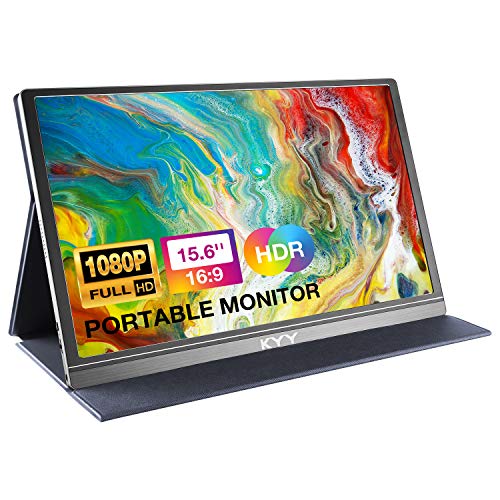
One Cable USB-C Extended Monitor, Dual Travel Screen for 12"-17'' Laptops, 360° Rotation & Kickstand,X90D (Driver Need) KYY Laptop Screen Extender, 15.6" 1080P Triple Portable Monitor for Laptop
One Cable USB-C Extended Monitor, Dual Travel Screen for 12"-17'' Laptops, 360° Rotation & Kickstand,X90D (Driver Need) KYY Laptop Screen Extender, 15.6" 1080P Triple Portable Monitor for Laptop
One Cable USB-C Extended Monitor, Dual Travel Screen
Best for: Users who want a single-cable connection and flexible rotation for mixed devices.
The listing emphasizes a one-cable USB-C connection, which reduces cable clutter. The 360° rotation and kickstand make it adaptable for presentations, reading, and video calls. Note that the listing mentions a driver requirement, so confirm compatibility with your system before purchase.
Key specs
- Designed for 12-inch to 17-inch laptops
- 360° rotation and kickstand
- USB-C single-cable connection
- Driver installation may be required
Pros
- Single-cable setup reduces desk clutter
- 360° rotation supports many viewing positions
- Covers a wide laptop size range
Cons
- Driver requirement can add setup steps on some systems
- Owner feedback on long-term durability of hinges is mixed in some reports
Bottom line: A flexible option for buyers who want a clean one-cable setup and can handle a short driver installation.
Buying Guide
Panel size and resolution
Most portable dual screen monitors fall between 14 and 15.6 inches. A 15.6-inch panel gives more working area, while 14-inch models are lighter and fit smaller bags. For text-heavy work, 1920 x 1080 (Full HD) is the common baseline, and 1920 x 1200 offers slightly more vertical space.
Good picks for this: ASUS ZenScreen Duo MB14FCD, Laptop Screen Extender 14.2″ FHD
Connection type
Check whether your laptop supports USB-C with DisplayPort Alt Mode or whether you need HDMI. Some setups need one cable for both power and video, while others require a separate power source. Confirm your laptop’s port specifications in its user manual before buying.
Good picks for this: One Cable USB-C Extended Monitor, InnoView Dual Portable Monitor 15.6″
Stand and rotation
Look for a built-in kickstand and rotation range if you plan to switch between landscape and portrait orientation. Rotation ranges vary widely, from around 90 degrees to over 300 degrees on some stacked models.
Good picks for this: 15.6″ Portable Dual Monitor Foldable Laptop Screen Extender, VisionOwl Portable Monitor Dual 15.6 Inch
Weight and thickness
If you travel often, weight matters more than most specs. Models around 1.5 to 2 pounds are noticeably easier to carry than heavier units. Measure the closed thickness, too, since slim profiles fit better in laptop sleeves.
Good picks for this: Laptop Screen Extender 14.2″ FHD, 15.6″ Portable Dual Monitor Foldable Laptop Screen Extender
Color accuracy
For photo or video review, look for sRGB coverage figures in the listing. Coverage near or above 100 percent suggests good color reproduction for general creative work. Basic panels are fine for documents and spreadsheets but may look washed out for color-critical tasks.
Good picks for this: VisionOwl Portable Monitor Dual 15.6 Inch, ASUS ZenScreen Duo MB14FCD
Mounting compatibility
VESA mount support lets you attach the monitor to a desk arm or wall bracket. Check whether the listing states VESA compatibility and what size pattern it uses, since mounting hardware is sold separately.
Good picks for this: VisionOwl Portable Monitor Dual 15.6 Inch, 15.6″ Portable Dual Monitor Foldable Laptop Screen Extender
Build quality and care
Foldable hinges are the most common point of wear. Avoid bending the panels beyond their intended range, keep the screens clean with a microfiber cloth, and store the monitor in a padded sleeve. Owner feedback on hinge durability varies, so a clear return policy is worth checking.
Good picks for this: ASUS ZenScreen Duo MB14FCD, One Cable USB-C Extended Monitor
FAQ
What is the best dual screen portable monitor for a laptop?
There is no single answer for everyone. The ASUS ZenScreen Duo MB14FCD is a balanced choice for daily mobile work, while the Laptop Screen Extender 14.2″ FHD suits buyers who prioritize weight above all else.
Do I need a driver to use a portable dual monitor?
Some models, including certain One Cable USB-C designs, may require a driver installation. Plug-and-play models generally do not. Check the product listing for driver requirements before buying.
Can a portable monitor be powered by my laptop alone?
Many USB-C models draw power from the laptop, but high-brightness or dual-panel units may need extra power. Models with pass-through charging can also charge the laptop at the same time.
What size laptop works with a portable dual monitor?
Most dual monitors are designed for laptops from about 12 to 17 inches, but fit depends on how the screen attaches. Check the listed compatibility range for your specific laptop size.
Is a stacked dual monitor better than a side-by-side one?
Stacked designs save horizontal desk space and suit narrow workstations. Side-by-side layouts are usually better for reading documents or comparing two windows at once.
Are portable dual monitors good for color-critical work?
Basic models are fine for documents and spreadsheets. For photo or video review, look for models that list high sRGB coverage, and remember that portable panels rarely match dedicated studio displays.
Conclusion
For most laptop users, the ASUS ZenScreen Duo MB14FCD offers the most balanced mix of build, connectivity, and everyday usability. If you work in tight spaces, the InnoView stacked design fits better. Creators who need stronger color can look at the VisionOwl model, while budget buyers will find the 15.6″ foldable extender a sensible starting point. Travelers who count every ounce should consider the 14.2-inch ultralight option, and those who want a single-cable setup will find the One Cable USB-C model worth a closer look. Match the screen size, connection type, and stand design to how you actually work, and the right choice usually becomes clear.
Sources
- Guidance on display power use and energy-efficient device settings (energy.gov)
- Standards and research related to display technology and electronics
- USB-C specifications and how USB-C supports video and power delivery
Before you buy: helpful guides
Related reading
- 7 Best Portable Dual Screen Monitor Options for Laptop Users (2026)
- 5 Best Portable Dual Screen Monitors for Laptop Users (2026)
About Owen Palmer
Owen Palmer is part of our editorial team and reviews and edits our consumer tech how-to & troubleshooting guides, checking product details against manufacturer specifications and owner feedback.