 By Lauren Holland
Updated November 2026
A solar panel charging power bank lets you top up phones and small devices when no wall outlet is nearby. The right pick depends on battery capacity, how fast the built-in or foldable panel charges, the number and type of output ports, and how well the unit handles water and dust. The six models below are ranked by how closely their listed specs fit those criteria, based on manufacturer specifications, brand reputation and common owner feedback patterns.
Our top picks at a glance
- 1
 TOP CHOICEBest overallSolar Charger Power Bank 49800mAh with 4 Built-in Cables & 4 Foldable PanelsView on Amazon
- 2
 TOP CHOICEBest for compact travelDurecopow Solar Charger Power Bank 20,000mAh, Portable Charger with 4 CablesView on Amazon
- 3
 TOP CHOICEBest for wireless chargingBLAVOR Solar Power Bank 20000mAh, Wireless Charger for Phones & Apple WatchView on Amazon
- 4
 Best for powering appliancesPortable AC Outlet Camping Solar Power Bank 146Wh with 40W Solar PanelView on Amazon
- 5
 Best budget pick10000mAh Solar Charger Power Bank with 30W Foldable Portable Solar PanelView on Amazon
- 6
 Best for multi-device householdsPD QC 3.0 Fast Charging, Built-in 2 Cables, Solar Charging, Outdoor EsView on Amazon
Our Top Picks
| Product | Best for | Key feature |
|---|---|---|
| Solar Charger Power Bank 49800mAh | Overall value | Large capacity, four panels |
| Durecopow Solar Charger Power Bank 20,000mAh | Compact travel | Four built-in cables |
| BLAVOR Solar Power Bank 20000mAh | Wireless charging | IPX5 waterproof rating |
| Portable AC Outlet Camping Solar Power Bank 146Wh | Powering appliances | AC outlet output |
| 10000mAh Solar Charger Power Bank | Budget pick | 30W foldable panel |
| PD QC 3.0 Solar Power Bank 50000mAh | Multi-device households | 50000mAh, 22.5W wireless |
Solar Charger Power Bank 49800mAh with 4 Built-in Cables & 4 Foldable Panels
Solar Charger Power Bank 49800mAh with 4 Built-in Cables & 4 Foldable Panels, 22.5W Fast Portable Phone Charger, External Battery Pack with USB-C in/Output & Flashlight for Outdoor Camping
Best for: Overall value and extended off-grid use
This unit suits campers and anyone planning multi-day trips who needs enough stored energy to charge several phones more than once. Its four foldable panels are designed to increase solar intake compared with single-panel designs.
Pros
- Very high 49800mAh capacity for repeated charges
- Built-in cables and flashlight add convenience
Cons
- Heavier than compact models, so less ideal for backpacking
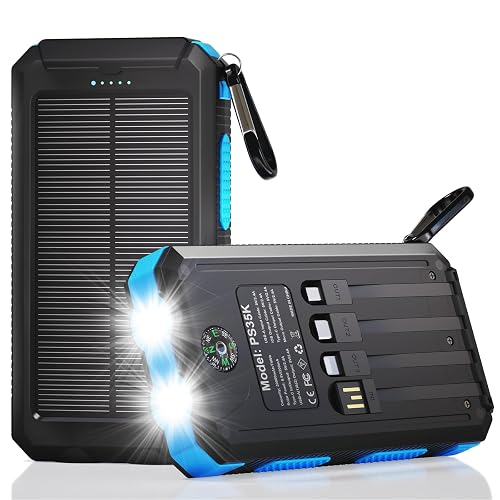
Durecopow Solar Charger Power Bank 20,000mAh, Portable Charger with 4 Cables
Durecopow Solar Charger Power Bank 20,000mAh, Portable Charger, 4 Cables 3 Ports Fast Charging External Battery Pack with USB C for Cell Phones, Solar Panel Charger with Dual Flashlight for Camping
Best for: Compact travel
Owners often describe this as a good fit for day hikes and short trips where a 20,000mAh battery is enough. The included cables and dual flashlight make it practical around a campsite.
Pros
- Four included cables reduce the need to carry extras
- Dual flashlight useful after dark
Cons
- Capacity is modest for charging several devices over multiple days
BLAVOR Solar Power Bank 20000mAh, Wireless Charger for Phones & Apple Watch
Portable battery pack, 4 built-in cables, 20W USB-C fast charging, IPX5 waterproof, camping flashlight, outdoor emergencies BLAVOR Solar Power Bank 20000mAh, Wireless Charger for Phones & Apple Watch
Best for: Wireless charging and wet conditions
This model fits users who want wireless pad charging alongside wired output and need protection from rain and splashes. The listed IPX5 rating covers water jets, not submersion.
Pros
- IPX5 water resistance per manufacturer specification
- Includes wireless charging for compatible phones and watches
Cons
- Wireless output is slower than wired charging
Portable AC Outlet Camping Solar Power Bank 146Wh with 40W Solar Panel
Portable Power Station with 40W Solar Panel, 100W Solar Powered Generator | Portable AC Outlet Camping Solar Power Bank 146Wh DC Battery Pack for Smart Device RV Outdoor Power Outage with Solar Charge
Best for: Powering appliances during outages and RV trips
This is closer to a portable power station than a phone bank. It suits people who need to run small AC appliances, such as a fan or CPAP-style device where the manufacturer lists compatibility, during outages or on the road.
Pros
- AC outlet output handles appliances that USB banks cannot
- 146Wh capacity supports several phone charges plus small loads
Cons
- Bulkier and heavier, and overkill if you only charge phones
10000mAh Solar Charger Power Bank with 30W Foldable Portable Solar Panel
10000mah Solar Charger Power Bank, 30W Foldable Portable Solar Panel, Fast Charging with 1 Type-C & 2 USB-A Ports, Ipx5 Waterproof, for Phone, Tablets & Multiple Devices, Camping Outdoor Use
Best for: Budget-conscious buyers and light use
A lower-capacity option for people who mainly need one or two emergency phone charges. Its foldable 30W panel and IPX5 rating make it a sensible entry point.
Pros
- Lightweight and easy to pack
- Type-C and two USB-A ports cover mixed devices
Cons
- 10000mAh holds less energy than larger units
Buying Guide
Battery Capacity
Capacity, listed in mAh or Wh, tells you roughly how many phone charges a power bank can deliver. Higher capacity means more backup power for longer trips or multi-day outages, but also more weight. For a basic phone top-up, a smaller unit is often enough; for a group or extended off-grid stay, look at the larger options.
Solar Panel Size and Charging Speed
A bigger or foldable panel collects more sunlight and recharges the battery faster, though real charging speed depends on sun strength, angle and weather. Built-in panels are convenient for quick top-ups, while separate foldable panels usually recharge the battery more quickly when you set them up in direct sun.
Ports and Cables
Check how many output ports you need and whether they include USB-C, USB-A or a standard AC outlet. Built-in cables are handy because you do not have to carry extras, and USB-C fast charging support matters if your phone or tablet uses it. If you plan to power a laptop or small appliance, an AC outlet becomes important.
Water and Dust Resistance
Camping and emergency use often means rain, dust and rough handling. An IPX5 rating indicates resistance to water jets, which suits outdoor conditions, but it does not make a device fully waterproof for submersion. Look for a sturdy build and protective ports if you expect harsh weather.
Extra Features
Built-in flashlights, wireless charging pads and pass-through charging can add real value in an outage or at a campsite. Consider which extras you will actually use so you do not pay for features that sit idle in your pack.
FAQ
How long does it take to charge a solar power bank?
Charging time depends on panel size, sunlight intensity and the battery’s capacity. Direct, strong sun will charge faster than shade or cloudy conditions. Many users plan for a full recharge to take a day of good sun, so check the manufacturer’s specifications for guidance. You may also like 7 Best Power Banks with Hand Crank for Camping and Emergencies.
Can a solar power bank charge a laptop?
Some larger units with an AC outlet or higher-wattage USB-C output can charge a laptop, while smaller power banks are better suited to phones and tablets. Check the laptop’s power requirements and the unit’s output rating before you rely on it. Running a laptop may drain the battery quickly.
Is an IPX5 rating enough for rain?
IPX5 indicates protection against low-pressure water jets from any direction, which is generally sufficient for rain and splashes. It does not mean the device can be submerged or used underwater. Keep ports covered when not in use to extend the unit’s life.
Can I charge the power bank and a device at the same time?
Many solar power banks support pass-through charging, which lets you charge the internal battery and a connected device simultaneously. Speeds may be reduced when both are active. Confirm this feature in the product details if you plan to use it often.
How should I store a solar power bank between trips?
Store the unit in a cool, dry place and keep the battery partially charged rather than fully drained or fully full for long periods. Recharge it every few months to maintain battery health. Keep the solar panel clean and free of dust so it performs well when you need it.
Conclusion
For most campers who want a balanced mix of capacity, foldable panel power and fast charging, the 49800mAh model is the strongest all-around choice. Travelers who prioritize a compact, lightweight kit will likely prefer the 20,000mAh Durecopow option, while those who want wireless charging or extra outage backup should look at the remaining models based on their specific needs.
Households preparing for emergencies or RV owners who need to run small appliances should consider the larger AC outlet power station, while light users who only need a simple phone top-up can choose the 10,000mAh unit. Matching capacity, ports and weather resistance to how you actually plan to use the power bank will lead to the best result.
Related reading
- Solar Panel and Power Bank Compared: 4 Best Picks for Camping and Emergencies
- 3 Best Power Bank Solar Charging Options for Camping and Emergencies (2026)
- Solar Power Bank 20000mah: How to Choose, Use and Maintain One (2026)
- Solar Battery Charger Power Bank: Does It Really Charge Your Phone?
About Lauren Holland
Lauren Holland is part of our editorial team and reviews and edits our consumer tech how-to & troubleshooting guides, checking product details against manufacturer specifications and owner feedback.