Quick answer
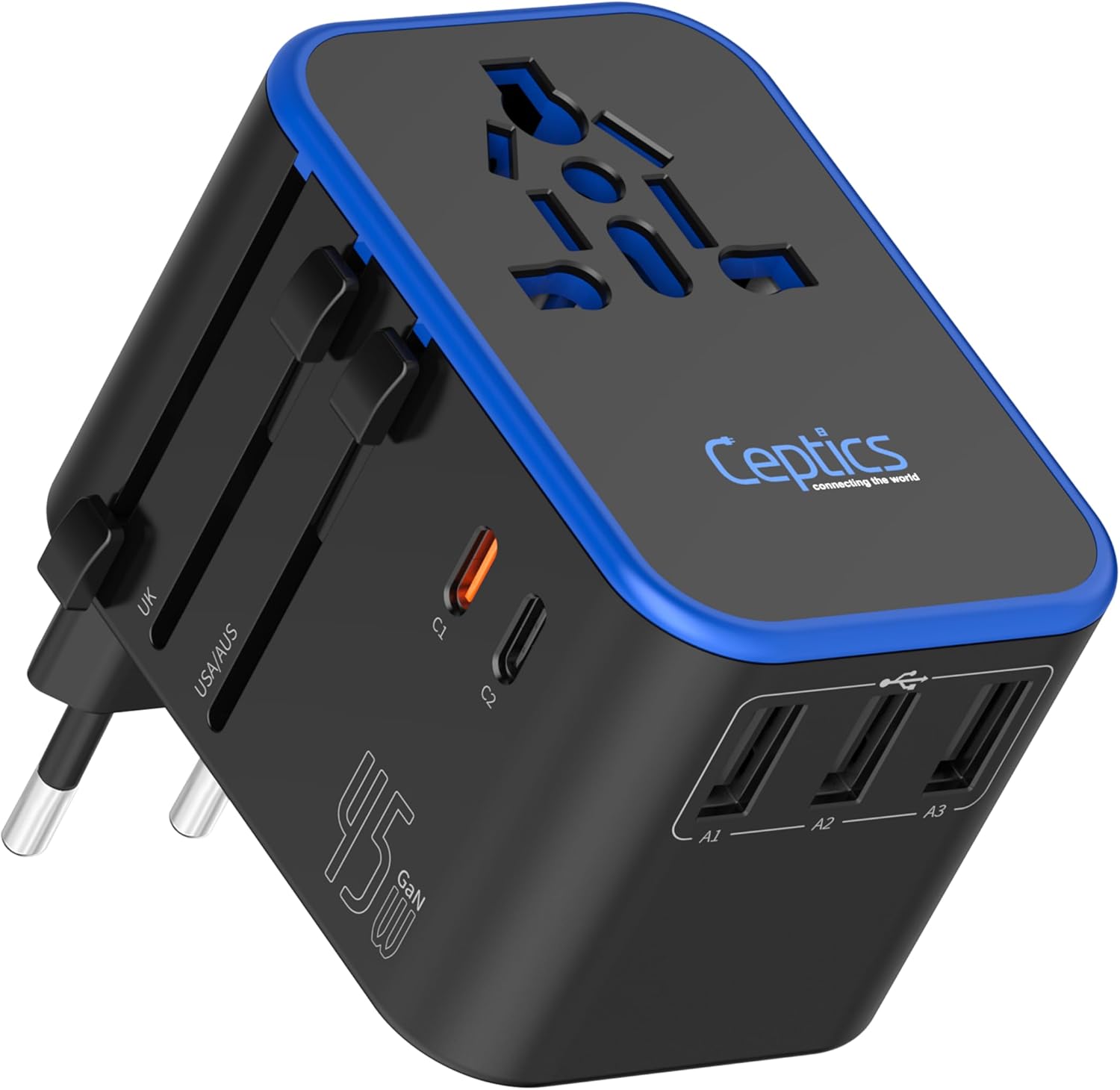
Our overall pick for the best travel adapter is the Ceptics 45W Universal Travel Adapter for its high-power output and many ports. The Anker Nano is best for minimalists, the NEWVANGA offers a simple all-in-one design, and the EPICKA 45W is a strong alternative for multi-device charging.
Finding the best travel adapter can be confusing with so many options claiming worldwide compatibility. The right choice depends on how many devices you need to power and how much space you have in your bag. We compared the manufacturer specifications for several widely available models to highlight their key features and limitations.
Our picks at a glance
Pros
- High total output (45W) for fast charging
- Seven total outlets (1 AC, 5 USB)
- Includes four international plug types
- Comes with an extra 8A fuse and has multiple safety certifications
Cons
- Not a voltage converter (for dual-voltage devices only)
- The listing does not mention surge protection
- Larger and heavier than some other options

Pros
- Exceptionally compact with a credit card-sized footprint
- Foldable and retractable pins
- Includes four international plug types
- Comes with an 18-month warranty
Cons
- Lower total power output (20W)
- AC outlet does not accept 3-prong grounded plugs
- Not a voltage converter (for dual-voltage devices only)

Pros
- Compact, all-in-one design with detachable plugs
- Built-in double 8A fuses for safety
- USB-C port supports 20W fast charging
- Lightweight at 3.2 ounces
Cons
- Only three total outlets (1 AC, 2 USB)
- Not a voltage converter (for dual-voltage devices only)
- The listing does not mention specific safety certifications like FCC or CE
How we chose
We compared manufacturer listings and specifications on Amazon as of October 2026. We did not test, use, or review these products hands-on. Our selections are based on comparing listed features like plug compatibility, number and type of ports, total power output, safety certifications, and physical dimensions.
Best Universal Travel Adapters: our picks in detail
1. Best overall: Ceptics 45W Universal Travel Adapter
The Ceptics 45W Universal Travel Adapter offers a comprehensive charging solution for international travel. It features a universal AC input socket, three USB-A ports, and two USB-C ports, with one USB-C port supporting Power Delivery and Quick Charge 3.0 for a total output of 45W. It includes four plug types (A, C, G, I) for use in over 150 countries.
Safety features include an 8A fuse (with an extra included), FCC, CE, and RoHS certifications, plug lock, and built-in safety shutters. The listing specifies it is not a voltage converter and is only for use with dual-voltage devices (100-240V).
Best for: Best for travelers who need to charge a laptop and multiple other devices simultaneously at high speed.
Pros
- High total output (45W) for fast charging
- Seven total outlets (1 AC, 5 USB)
- Includes four international plug types
- Comes with an extra 8A fuse and has multiple safety certifications
Cons
- Not a voltage converter (for dual-voltage devices only)
- The listing does not mention surge protection
- Larger and heavier than some other options
2. Best for minimalists: Anker Nano Travel Adapter (20W)
The Anker Nano Travel Adapter prioritizes a compact, credit card-sized footprint with foldable pins. It offers five outlets: one AC outlet, two USB-A ports, and two USB-C ports, with a total USB output of 20W. A single USB-C port can deliver up to 20W. It includes Type A, C, G, and I plugs for use in over 200 countries.
The AC outlet uses a 2-pin design for safety but does not support 3-prong grounded plugs from the EU, UK, or grounded laptop chargers. The listing includes an 18-month warranty and notes it is not a voltage converter.
Best for: Best for travelers who prioritize the smallest possible size and only need to charge phones and tablets.
Pros
- Exceptionally compact with a credit card-sized footprint
- Foldable and retractable pins
- Includes four international plug types
- Comes with an 18-month warranty
Cons
- Lower total power output (20W)
- AC outlet does not accept 3-prong grounded plugs
- Not a voltage converter (for dual-voltage devices only)
3. Best simple all-in-one: NEWVANGA Universal Travel Adapter
The NEWVANGA Universal Travel Adapter is a compact, all-in-one unit with five detachable input plugs (Type A, C, G, I) for use in over 200 countries. It provides one universal AC outlet and one USB-C port that supports fast charging up to 20W. It also includes a USB-A port.
Safety features include built-in safety shutters and dual 8A fuses for over-current protection. The listing notes it is not a voltage converter and has a maximum power rating of 880W at 110V or 1920W at 240V. It is designed for dual-voltage devices (100-240V).
Best for: Best for travelers who want a straightforward, integrated adapter with basic USB fast charging.
Pros
- Compact, all-in-one design with detachable plugs
- Built-in double 8A fuses for safety
- USB-C port supports 20W fast charging
- Lightweight at 3.2 ounces
Cons
- Only three total outlets (1 AC, 2 USB)
- Not a voltage converter (for dual-voltage devices only)
- The listing does not mention specific safety certifications like FCC or CE
Travel adapter picks at a glance
| Adapter | Total Outlets | Max USB Power | Plug Types | Key Safety Feature |
|---|---|---|---|---|
| Ceptics 45W | 7 (1 AC, 5 USB) | 45W | A, C, G, I | 8A fuse (extra included) |
| Anker Nano (20W) | 5 (1 AC, 4 USB) | 20W | A, C, G, I | 2-pin AC design |
| NEWVANGA | 3 (1 AC, 2 USB) | 20W (USB-C) | A, C, G, I | Double 8A fuses |
| EPICKA 45W | 6 (1 AC, 5 USB) | 45W | 5 types listed | 10A fuse |
How to choose a travel adapter
Selecting the best travel adapter is more than just finding one that fits the wall socket. You need to consider what you’re plugging in and how you’ll carry it. The most critical rule is that these devices are adapters, not voltage converters. They change the shape of the plug, not the electrical current. You must ensure every device you plug into the AC outlet supports dual voltage (typically labeled 100-240V, 50/60Hz). Using a single-voltage device (like many hair dryers) with just an adapter can damage the device and is a safety hazard. For a detailed explanation, see our guide on travel adapters vs. voltage converters.
What to look for
- Plug Compatibility: Check that the adapter includes the plug types for your destination countries (common types are A, C, G, and I).
- Power Output (Wattage): If you need to charge a laptop or multiple devices quickly, look for a higher total USB output (e.g., 45W vs. 20W).
- Number and Type of Ports: Count how many AC outlets and USB ports you need. USB-C ports with Power Delivery (PD) are best for fast-charging modern phones and tablets.
- Size and Design: If bag space is tight, look for compact models with foldable pins. All-in-one designs are convenient but can be bulkier than slim plug adapters.
- Safety Features: Look for listed certifications (FCC, CE, RoHS), built-in fuses, and safety shutters that prevent accidental contact with live parts.
Remember, even if an adapter has an AC outlet, it may not support high-wattage appliances like curling irons or travel kettles. Always follow the manufacturer’s manual for your devices and the adapter. For more on what to pack, check out our list of portable gadgets for travel.
FAQ
What’s the difference between a travel adapter and a voltage converter?
A travel adapter only changes the physical shape of a plug so it fits into a foreign wall outlet. It does not change the electrical voltage coming from the wall. A voltage converter (or transformer) actually changes the voltage, for example from 240V to 120V. Most modern electronics like phones and laptops have built-in chargers that accept 100-240V, so they only need an adapter. High-power appliances like hair dryers often do not and would require a converter. You can learn more in our dedicated article on travel adapters vs. voltage converters.
Can I use my hair dryer or straightener with a travel adapter?
It depends on the device. Most travel adapters, including all in this roundup, are not voltage converters. If your hair dryer or straightener is rated for 110V only (common in North America), it will not work properly and could be damaged or cause a fire if plugged into a 240V outlet overseas, even with an adapter. You must check the label on your appliance for its voltage rating. Many adapter listings explicitly warn against using them with such devices.
Why do some adapters have fuses?
Fuses are a safety feature designed to protect the adapter and your devices. If there is a power surge or the connected device draws too much current (amperage), the fuse will “blow” or pop, breaking the circuit and cutting off the power. This can prevent damage from electrical faults. Some adapters come with a spare fuse so you can replace it if needed.
Are universal travel adapters allowed in carry-on luggage?
Yes, travel adapters and chargers are generally permitted in both carry-on and checked baggage by the TSA and FAA. However, it’s always a good idea to check the latest guidelines from the TSA and FAA before you travel, as regulations can change.
References
- Amazon product listings and manufacturer specifications (accessed October 2026)
- Transportation Security Administration. What Can I Bring? https://www.tsa.gov/travel/security-screening/whatcanibring/all
- Federal Aviation Administration. Pack Safe. https://www.faa.gov/hazmat/packsafe