
 By Lauren Holland
Updated November 2026
Shopping for the best power bank with solar panels means balancing battery capacity, panel output, charging speed and durability. Most solar models trade some charging speed for portability, so the right choice depends on whether you need a phone top-up on a hike or a larger reserve for an outage. The picks below are chosen from product listings, brand reputation and common owner feedback, with attention to capacity, built-in cables, waterproof ratings and flashlight features.
Our top picks at a glance
- 1
 TOP CHOICEBest overallBLAVOR Solar Power Bank 20000mAh, Wireless Charger for Phones & Apple WatchView on Amazon
- 2
 TOP CHOICEBest for high capacitySolar Charger Power Bank 50000mAh, PD QC 3.0 with Wireless ChargingView on Amazon
- 3
 TOP CHOICEBest for multi-day tripsSolar Charger Power Bank 38800mAh, 22.5W USB-C Fast ChargingView on Amazon
- 4
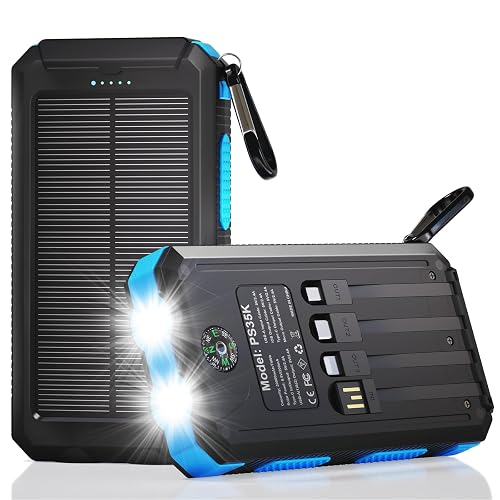 Best for three-port chargingDurecopow Solar Charger Power Bank 20,000mAh, 4 Cables 3 PortsView on Amazon
- 5
 Best for home backupPortable AC Outlet Camping Solar Power Bank 146WhView on Amazon
- 6
 Best for rugged outdoor useToughTested 24000mAh Solar Power Bank, LED Flashlight, USB-C Fast ChargingView on Amazon
- 7
 Best for compact carryMiady 2-Pack UL Listed Solar Power Bank 10,000mAh, 22.5W Fast ChargingView on Amazon
Our Top Picks
| Product | Best for | Key feature |
|---|---|---|
| BLAVOR Solar Power Bank 20000mAh | Camping and emergencies | IPX5 waterproof, four cables |
| Solar Charger Power Bank 50000mAh | High capacity | 22.5W, built-in wireless |
| Solar Charger Power Bank 38800mAh | Multi-day trips | Four built-in cables |
| Durecopow Solar Charger Power Bank 20,000mAh | Charging several devices | Three ports, dual flashlight |
| Portable AC Outlet Camping Solar Power Bank 146Wh | Home backup | AC outlet, 40W panel |
| ToughTested 24000mAh Solar Power Bank | Rugged outdoor use | IP66 rated protection |
| Miady 2-Pack Solar Power Bank 10,000mAh | Compact carry | 22.5W, two-pack |
BLAVOR Solar Power Bank 20000mAh, Wireless Charger for Phones & Apple Watch
Portable battery pack, 4 built-in cables, 20W USB-C fast charging, IPX5 waterproof, camping flashlight, outdoor emergencies BLAVOR Solar Power Bank 20000mAh, Wireless Charger for Phones & Apple Watch
Best for: Camping and emergencies
This suits hikers and campers who want one pack that handles phones, a watch and a flashlight.
- Pros: IPX5 waterproofing and four built-in cables.
- Pros: 20W USB-C fast charging.
- Cons: Solar recharge is slow in shade or overcast weather.
Solar Charger Power Bank 50000mAh, PD QC 3.0 with Wireless Charging
PD QC 3.0 Fast Charging, Built-in 2 Cables, Solar Charging, Outdoor Essentials & Bright Flashlight, External Battery Pack 50000mAh Solar Power Bank 22.5W Wireless Portable Solar Charger
Best for: High capacity
This fits users who want several full phone charges between solar top-ups, such as multi-day trips.
- Pros: Very large 50000mAh capacity.
- Pros: Built-in cables plus wireless output.
- Cons: Considerably heavier than smaller packs.
Solar Charger Power Bank 38800mAh, 22.5W USB-C Fast Charging
Solar Charger Power Bank 38800mAh, 22.5W USB-C Fast Charging Portable Charger with 4 Built-in Cables, External Battery Pack with Dual LED Emergency Flashlights for Camping, Hiking, Outdoor Use
Best for: Multi-day trips
A good match for backpackers who need a balance of capacity and built-in convenience. If you want more background, see 4 Best Chargers for Power Bank: Top Picks Compared (2026).
- Pros: Four built-in cables reduce what you need to carry.
- Pros: Dual LED emergency flashlights.
- Cons: Solar panel output is modest, so plan on wall or car top-ups.
Durecopow Solar Charger Power Bank 20,000mAh, 4 Cables 3 Ports
Durecopow Solar Charger Power Bank 20,000mAh, Portable Charger, 4 Cables 3 Ports Fast Charging External Battery Pack with USB C for Cell Phones, Solar Panel Charger with Dual Flashlight for Camping
Best for: Charging several devices
Useful for groups or families who need to charge more than one device at a time.
- Pros: Three output ports and four cables.
- Pros: Dual flashlight for camp use.
- Cons: Combined output is split across ports, so multi-device charging is slower.
Portable AC Outlet Camping Solar Power Bank 146Wh
Portable Power Station with 40W Solar Panel, 100W Solar Powered Generator | Portable AC Outlet Camping Solar Power Bank 146Wh DC Battery Pack for Smart Device RV Outdoor Power Outage with Solar Charge
Best for: Home backup
This suits people who want to run small household loads during a power outage, not just charge a phone.
- Pros: AC outlet for small appliances.
- Pros: Pairs with a 40W solar panel.
- Cons: Much bulkier than a typical power bank.
ToughTested 24000mAh Solar Power Bank, LED Flashlight, USB-C Fast Charging
Fast charging power bank with LED flashlight and IP66 rugged protection for camping, travel, and emergencies ToughTested 24000mAh Solar Power Bank, LED Flashlight, USB-C Fast Charging
Best for: Rugged outdoor use
A fit for users who expect dust, rain and drops on job sites or trails.
- Pros: IP66 rated protection against dust and water jets.
- Pros: Built-in LED flashlight.
- Cons: Rugged housings add weight and bulk.
Buying Guide
Battery Capacity and Real-World Use
Capacity is listed in milliamp-hours (mAh) or watt-hours (Wh), and the usable amount is always lower than the printed number because some energy is lost in conversion. A 10,000mAh bank is typically enough for a phone or two full charges, while 20,000mAh and above can support tablets, earbuds, and small devices over several days. Match the capacity to how many devices you plan to charge and for how long.
Solar Panel Output and Charging Speed
Solar charging is slow compared with a wall outlet, so the panel’s wattage and surface area matter. Expect to recharge the bank through sunlight over many hours, and treat solar as a backup or top-up method rather than a fast charging source. Larger panels and folding designs generally collect more energy but add bulk.
Ports, Built-In Cables, and Fast Charging
Check whether the bank offers USB-C with Power Delivery or similar fast charging, and whether the output ports match your devices. Built-in cables are convenient for camping and travel, but confirm they include the connector type you use most. Multiple ports let you charge several devices at once, though total output is usually shared among them.
Durability and Weather Protection
If you will use the bank outdoors, look at the ingress protection (IP) rating. IPX5 indicates resistance to water jets, while higher ratings such as IP66 indicate stronger protection against dust and powerful spray. Rugged housings and a sturdy build help the bank survive drops and rough handling on trails or job sites.
Extra Features Like Flashlights and Wireless Charging
Built-in LED flashlights are useful for camping and emergencies, and some models include SOS or multiple light modes. Wireless charging pads are handy for compatible phones and smartwatches, but they draw more power and can reduce overall efficiency. Decide which extras you will actually use before paying for them.
FAQ
How long does it take to charge a solar power bank?
Charging time depends on panel size, sunlight strength, and the bank’s capacity. Under direct sun, many models take anywhere from a full day to several days to reach full capacity. Partial shade or cloudy weather will extend that time considerably.
Can a solar power bank charge a laptop?
Some larger models with higher capacity and USB-C Power Delivery can top up small laptops, but most standard power banks are better suited to phones, tablets, and accessories. Check the advertised output wattage and confirm it meets your laptop’s charging requirements. Solar input alone will rarely keep up with a laptop’s power draw.
Is a solar power bank waterproof?
Not all are, so check the IP rating listed by the manufacturer. An IPX5 rating means the unit can handle water splashes and jets but is not meant for submersion. Keep ports covered and avoid immersing any power bank unless the product specifically says it is rated for that.
Do solar power banks work on cloudy days?
They still collect some energy on cloudy days, but output is much lower than in direct sunlight. It is wise to charge the bank from a wall outlet before a trip so you are not relying only on the sun. Think of solar as a supplement rather than your main charging method. For another angle, check out 7 Best MagSafe Power Banks: Top Picks Compared (2026).
How often should I recharge the battery pack itself?
Storing a lithium-based battery at a moderate charge level, roughly between 20 and 80 percent, helps preserve its lifespan. Avoid leaving it fully drained for long periods, and recharge it periodically even if you are not using it. Keep the bank away from extreme heat, which can shorten battery life.
Conclusion
If you want a compact option for phone top-ups on day hikes, a smaller 10,000mAh to 20,000mAh model with a flashlight and solar panel is a practical choice. Travelers and campers who need to charge several devices over multiple days should look at the 20,000mAh to 40,000mAh range with multiple ports and stronger weather protection.
For extended outages, RV trips, or charging larger electronics, a high-capacity portable power station with a dedicated solar panel makes the most sense. Match your choice to your daily power needs, how much sun you expect, and how rugged your use will be.
Related reading
- Solar Panel and Power Bank Compared: 4 Best Picks for Camping and Emergencies
- Best Solar Charger Power Bank: 5 Factors to Check Before You Buy (2026)
- 7 Best Solar Portable Charger Power Banks for Camping and Emergencies (2026)
About Lauren Holland
Lauren Holland is part of our editorial team and reviews and edits our consumer tech how-to & troubleshooting guides, checking product details against manufacturer specifications and owner feedback.





