By Lauren Holland
Updated November 2026
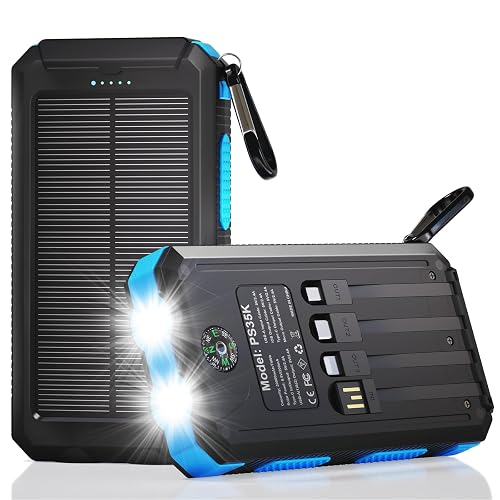
A 10000mah power bank solar model stores enough energy for roughly one to two full phone charges, and its built-in panel can top it up when you have no wall outlet. This guide shows you how to judge the battery and panel specs, estimate realistic solar charging times, and get the most from one on a trip or during a power outage. Think of it as a checklist for separating useful solar power from marketing claims.
Understand what 10000mAh actually gives you
The milliamp-hour rating on a power bank is the capacity of the cells before conversion losses. Because the internal circuitry, USB conversion and heat all consume energy, the usable output is lower. Most manufacturers and independent reviewers estimate usable capacity at around 60 to 70 percent of the rated figure when charging through USB.
Shopping for one? See our guide: 6 Best Blavor Solar Power Banks for Camping and Emergencies (2026).
In practical terms, a 10000mAh pack at 3.7V holds about 37Wh. After losses, expect roughly 22 to 26Wh delivered. A typical modern smartphone battery of about 12 to 15Wh means one full charge, and sometimes a bit more.
Quick capacity estimate
- Find your phone’s battery capacity in mAh (check the spec sheet).
- Multiply the pack’s 10000mAh by 0.65 to estimate usable output.
- Divide that number by your phone’s battery mAh to estimate full charges.
Example: 10000 × 0.65 = 6500mAh usable. Divided by a 4000mAh phone battery, that is about 1.6 charges.
Evaluate the solar panel before you buy
Solar power bank marketing often focuses on the battery and skips the panel. The panel size and efficiency decide whether solar is a real charging source or a novelty. Look for these specs:
- Panel wattage: Most compact units list between about 1W and 5W. Under 2W is mainly a trickle charger.
- Solar input rating: Check whether the manufacturer lists input in volts and milliamps, such as 5V/1A.
- Panel surface area: A larger folding panel captures more light, though it adds bulk.
- Pass-through charging: Confirm the pack can charge from the panel and a wall or USB source at the same time, and whether it can power devices while charging.
Realistic solar charging times
Manufacturers usually list charge times under ideal direct sunlight. Owners often report much slower results when the panel is angled poorly, shaded, behind a window or under cloud cover. As a rough planning figure, a 1W to 2W panel in good direct sun may take a full day or more to fill a 10000mAh pack. Treat solar as a slow top-up, not a fast charger.
| Panel output | Typical use | Expected result (direct sun) |
|---|---|---|
| Under 2W | Emergency trickle top-up | Slow; mostly maintains charge |
| 2W to 4W | Day hikes, camping | Partial recharge over several hours |
| Over 4W (folding panel) | Base camp, extended outdoor use | Faster recharge with good angling |
Step-by-step: charging a 10000mAh solar power bank
The method you use affects how much energy you actually collect. Follow these steps for the best results.
- Charge it fully first. Use a wall adapter before your trip so the pack starts at 100 percent.
- Place the panel in direct sun. Face it toward the sun and tilt it so light hits the surface at close to a right angle.
- Keep the panel clean. Dust, sand and fingerprints reduce output noticeably.
- Avoid heat buildup. Lithium cells charge less efficiently when hot. Shade the battery body if the panel is in full sun on a hot day.
- Check the indicator lights. Most units show charge level with LEDs. Note the level before and after a session to learn your pack’s real intake.
Tools and supplies that help
- A small carabiner or strap to hang the panel from a backpack for angle and airflow.
- A microfiber cloth for cleaning the panel.
- A short USB-C or micro USB cable for cable-based top-ups when you have a wall outlet.
Common mistakes to avoid
- Expecting full charges from sunlight alone. Plan on the panel supplementing, not replacing, a wall charger.
- Leaving the panel flat on the ground. Flat placement wastes a lot of light, especially at midday angles.
- Charging through a window. Glass blocks much of the useful spectrum and heats the pack.
- Storing the pack empty for long periods. Lithium batteries age faster at very low charge. Top it up every few months.
- Trusting capacity labels. Compare the rated mAh with the output specs and independent reviews, not the box alone.
Tips for getting the most from solar
- Use the pack’s pass-through feature to run a phone directly from the panel during the day.
- Track one outdoor session to learn how many hours of sun your setup needs.
- If you travel often, pair it with a wall charger so you are never stuck with solar alone.
For broader solar options and comparisons, see Solar Power Bank 20000mah: How to Choose, Use and Maintain One (2026) and Solar Panel and Power Bank Compared: 4 Best Picks for Camping and Emergencies. If you are weighing a larger unit, Power Bank Solar Powered: How to Choose and Use One in 2026 covers the trade-offs in more detail.
Recommended gear
- Anker PowerCore 10000: A widely sold compact 10000mAh battery that pairs well with a separate solar panel for a lightweight setup. View on Amazon
- BigBlue 28W Solar Charger: A foldable panel with multiple USB outputs, useful when you want more solar input than a built-in panel provides. View on Amazon
- Anker 10000mAh Wireless Power Bank with USB-C: Suits users who want a compact pack with fast USB-C output for modern phones. View on Amazon
FAQ
How many phone charges does a 10000mAh solar power bank give?
Usually about one to two full charges for a typical smartphone, because conversion losses reduce usable output to roughly 60 to 70 percent of the rated capacity.
How long does the solar panel take to charge the battery?
Under good direct sun, small built-in panels often need a day or more for a full charge. Larger folding panels are faster. Results vary with angle, weather and panel size.
Can I charge a phone and the battery at the same time?
Some models support pass-through charging, but many do not. Check the product specifications before relying on this feature.
Does a solar power bank work on cloudy days?
It still collects some energy in diffuse light, but output drops sharply. Expect much slower charging than in direct sun.
Is it safe to leave a solar power bank in the sun?
Avoid leaving it in hot cars or on hot surfaces for long periods, since heat can damage lithium cells. Shade the battery body during extended direct-sun use.
Can a 10000mAh solar power bank charge a laptop?
Generally no. Laptops need far more energy than a 10000mAh pack can deliver. Some larger power stations are designed for laptop use instead.
How often should I recharge the battery?
Top it up every few months if stored, and recharge after each use. Avoid keeping it at zero for long periods.
Conclusion
A 10000mah power bank solar unit works best as a backup source: charge it from a wall before you go, and let the panel top it up when you are outdoors. Judge the panel wattage and realistic charge times, not just the battery label. Set your expectations around one to two phone charges, and you will get reliable use from it.
Related reading
- Solar Battery Charger Power Bank: Does It Really Charge Your Phone?
- Jackery Solar Power Bank: How to Charge Devices Outdoors in 2026
- Best Solar Charger Power Bank: 5 Factors to Check Before You Buy (2026)
Ready to choose one?
About Lauren Holland
Lauren Holland is part of our editorial team and reviews and edits our consumer tech how-to & troubleshooting guides, checking product details against manufacturer specifications and owner feedback.